
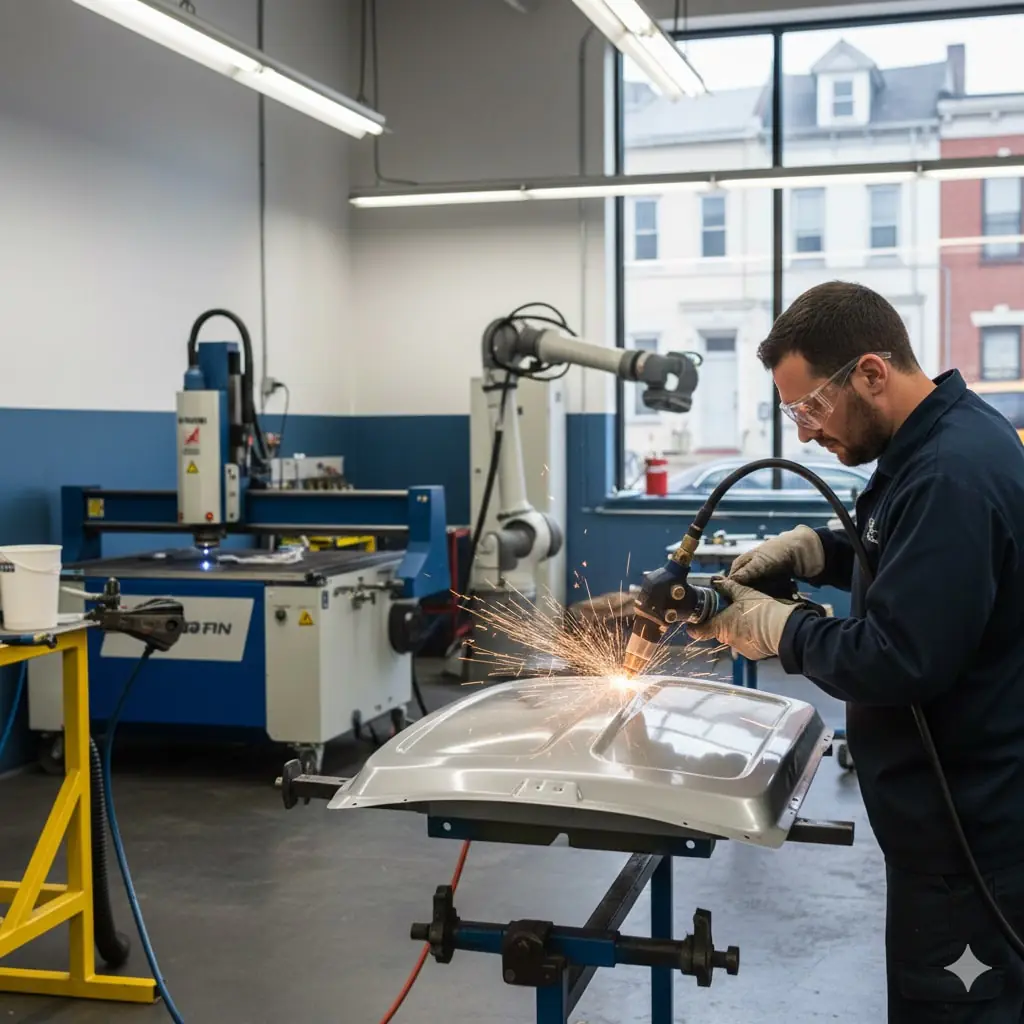
When you look at a modern vehicle, you see the sleek lines, the glossy paint, and the comfortable interior. Beneath that surface is an engineered skeleton designed to save your life.
In the past, auto body repair was often considered a brute-force trade. It involved heavy hammers and body fillers to hide imperfections. Today, that approach is obsolete.
Modern vehicles require modern techniques, redefining standards for auto body Philadelphia shops.
How Automobile Chassis Have Evolved Over Time
To understand why we use advanced metal fabrication tools, you first have to understand how cars have changed. Decades ago, vehicles were built with mild steel. It was thick, heavy, and soft. If it got bent, you would heat it and bend it right back.
Modern vehicles are different. They use a “unibody” made from a mix of materials. These can be High-Strength Steel (HSS), Ultra-High-Strength Steel (UHSS), aluminum, and even carbon fiber. These materials are lighter but stronger to protect passengers.
In a modern vehicle, the car metal thickness is not uniform. Engineers vary the gauge (thickness) of the steel throughout the car.
The metal is thinner in “crumple zones”, areas designed to absorb impact energy. Conversely, it is thicker in the surroundings of the cabin to prevent intrusion.
This changes the structural integrity of that specific zone. The precise car metal thickness ensures the vehicle’s performance during a crash.
Laser Precision is the Game Changer
Restoring a vehicle to factory standards is a game of geometry. Even as little as 3 millimeters can throw off your alignment, causing uneven tire wear. It can even prevent airbags from deploying at the right millisecond.
For precision collision repair, the best shops in Philadelphia go beyond traditional methods. We use computerized 3D laser measuring systems.
These systems work by placing targets on specific control points of the chassis. A laser scanner maps the vehicle’s frame, comparing it with the original digital blueprints.
Technology like this reveals structural deviations that are invisible to the human eye. It tells us exactly how much the frame has shifted, down to the millimeter. It then guides the hydraulic pulling equipment to restore the chassis.
Replicating Factory Bonds with the Art of Welding
Once the frame is straight, the damaged panels need replacement. The difference between a budget shop and a professional facility becomes obvious here.
In the factory, cars are assembled using robotic resistance spot welders. These robots apply massive pressure and electricity to fuse metals. Traditional repair shops often use MIG welding, which introduces a lot of heat.
On modern Ultra-High-Strength Steel, a weak zone forms. To combat this, top-tier shops invest in Squeeze-Type Resistance Spot Welders (STRSW).
These metal fabrication tools replicate the factory welds by applying the correct pressure and current. Altering the car metal thickness through incorrect welding reduces crashworthiness.
Aluminum Repair and Its Magic
Aluminum behaves differently from steel. It doesn’t have “memory”, meaning if you dent it, it doesn’t want to pop back into place; it wants to tear.
Furthermore, steel and aluminum cannot cross-contaminate. If steel dust from a grinder lands on an aluminum panel, it causes galvanic corrosion. As a reason, special equipment is necessary for precision collision repair.
Why You Need Specialized Care for Your Car
Driving in our city presents unique challenges. Along with that, the salt on our roads during winter accelerates corrosion.
When searching for an auto body shop, you should prioritize these factors. A repair that isn’t sealed will rust out faster in our climate.
Advanced fabrication isn’t about structural safety; it’s also about longevity. By using the right tools to cut, weld, and seal the metal, we ensure that the repair lasts as long as you own the car.
The Human Element in High-Tech Repair
While we rely on advanced metal fabrication tools, their efficacy ultimately lies in the skill of their operators. Technology cannot replace experience.
That’s why training and process matter just as much as equipment. Human expertise and precise execution together ensure true precision collision repair.
Precision You Can Trust
Your car is one of the biggest investments you will ever make. It carries your most precious cargo: your family. Safety features are non-negotiable.
When a car has been in a collision, its structural integrity is at risk. “Good enough” is not acceptable when it comes to the safety cage that protects your children.
If you have been in a collision, trust the experts who understand the science behind the steel. When choosing an auto body Philadelphia shop, our exceptional record speaks for itself.
Contact Dr. Ralph’s today and experience the peace of mind that comes with true precision repair.